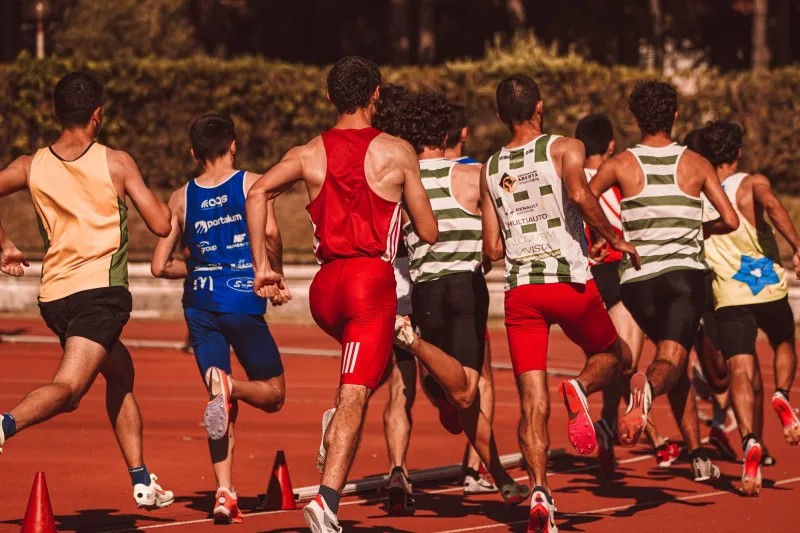
Running Faster by Running Together: What Relay Training Does to You That Solo Miles Never Could
Ask most competitive runners what made them faster, and they'll talk about mileage, interval sessions, maybe a new coach. What they probably won't mention is their teammates. But for a growing number of athletes in Modesto's relay community, the single biggest performance breakthrough didn't come from a training plan — it came from joining one.
There's something happening inside relay programs that pure solo training just doesn't replicate. Call it the relay effect. And once you understand what it actually does to your body and your brain, it starts to make a whole lot of sense.
The Pressure That Actually Helps You
Everyone who's competed solo knows what race-day nerves feel like. But the anxiety of knowing that your performance directly affects three other people? That's a different animal entirely.
Sports psychologists have a term for it: co-active performance pressure. When your effort has consequences for others you care about, your nervous system responds differently than it does when you're only accountable to yourself. Studies on team-dependent tasks consistently show that people push harder, sustain effort longer, and tolerate more discomfort when they know a teammate is counting on them.
For relay runners, this plays out in a very specific way. Every rep in practice, every tempo run, every drills session carries a kind of weight that solo training rarely delivers. You're not just running for a number on a stopwatch — you're running so you don't let your team down. That shift in motivation, subtle as it sounds, creates measurable physiological adaptations over time.
"I used to quit intervals when it got uncomfortable," says Marcus T., a 400-meter specialist who joined a Modesto relay program two seasons ago. "Not in a dramatic way — just a few seconds early, a little slower than I should've been. When I started training with the relay squad, something changed. I couldn't let myself be the weak link. I started finishing every rep the right way, every single time. My times dropped almost immediately."
Pacing Discipline You Can't Fake
One of the most underrated benefits of relay training is what it does for your sense of pace. In individual racing, going out too hot is a personal problem. In a relay, it's a team catastrophe.
Relay runners — especially those running middle legs — develop an almost instinctive relationship with pace management. You learn to hit your split on demand, not just run hard and hope for the best. That kind of controlled output is a skill, and it transfers directly to individual racing.
Coach Diana R., who works with several relay squads in the Modesto area, has seen this play out repeatedly. "Athletes who come through relay programs almost always have better race execution in individual events," she explains. "They know how to go out controlled, hold form under fatigue, and close strong. Those are skills you develop when you have to hand off at a specific point in a specific condition. You can't just blow up and recover — you have to hit your mark."
The neuroscience here is interesting too. Repeated, precise pacing efforts appear to strengthen the brain's interoceptive awareness — essentially your ability to accurately sense what your body is doing in real time. Relay athletes who run the same leg week after week develop a finely tuned internal metronome that solo runners, who often rely more on external feedback like GPS watches, may never fully build.
Consistency as a Team Obligation
Here's something solo runners rarely talk about: it's pretty easy to have a bad week and just... let it slide. Skip a workout, cut a run short, take an extra rest day. When you're only answering to yourself, the consequences feel abstract.
In a relay program, inconsistency has a face. It's the teammate who's relying on you to show up sharp on race day. That social accountability — real, human, not algorithmic — is one of the most powerful training tools in existence.
Research on exercise adherence consistently finds that people who train in socially connected groups maintain higher training loads over time than those who train alone. For relay athletes, this means more quality sessions completed, fewer skipped workouts, and a longer runway of consistent training that compounds into genuine fitness gains.
Jasmine W., a sprinter who spent three years grinding through solo track training before joining a Modesto relay team, felt the difference almost immediately. "I was always motivated — on paper. But I'd find reasons to cut things short. When I joined the relay group, those reasons disappeared. I didn't want to be the person who showed up undertrained. That accountability made me more consistent than I'd ever been, and that consistency is what actually moved the needle for me. I ran a PR in the open 200 six weeks after my first relay meet."
The Biomechanical Edge You Didn't Expect
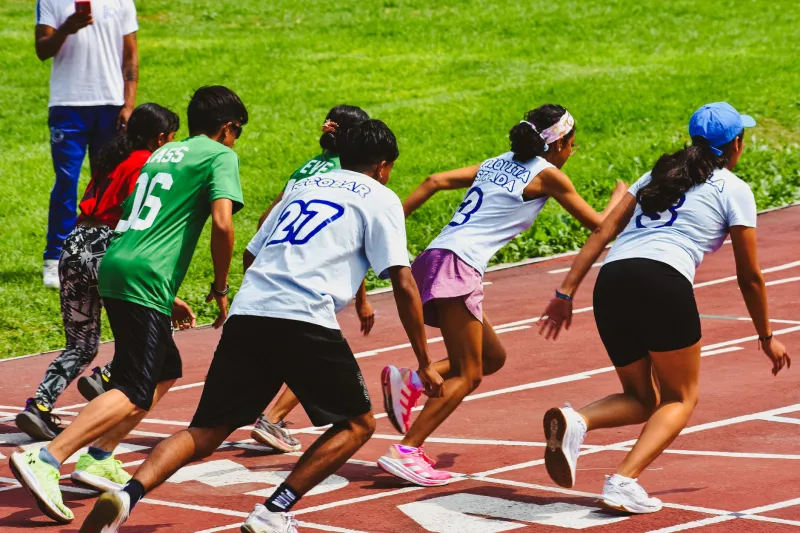
Relay training also has some sneaky biomechanical benefits that don't get nearly enough attention. The baton exchange zone demands that runners hit precise velocities at precise moments — which means a lot of practice running at controlled, high speeds while maintaining form under pressure.
For the outgoing runner in an exchange, accelerating to race speed from a standing or moving start and then holding that speed through a handoff window is a remarkable neuromuscular drill. It trains explosive acceleration, speed maintenance, and the ability to run relaxed at high intensity — qualities that translate directly to individual sprint and middle-distance events.
Coach Diana points out that relay exchange practice is essentially structured speed work with a built-in purpose. "When you're running exchange drills, you're doing high-quality reps at race pace or faster, but the focus is on the execution of the handoff. Athletes don't think of it as speed work — but that's exactly what it is. And because they're focused on the task rather than the effort, they often run faster than they would in a traditional interval session."
What Solo Runners Are Missing
None of this is to say that individual training is inferior — it's not. Solo work builds the aerobic base, the mental toughness, and the self-reliance that every competitive runner needs. But relay training fills gaps that solo miles simply can't reach.
The combination of social accountability, pacing precision, sustained motivation, and high-quality team-based speed work creates a training environment that accelerates development in ways that are genuinely hard to replicate on your own. Modesto relay athletes aren't just getting faster at passing batons — they're becoming more complete runners across the board.
If you've been grinding through individual training and wondering why the clock isn't moving the way you want, the answer might not be more miles. It might be more teammates.
Because sometimes the fastest way forward is running together.