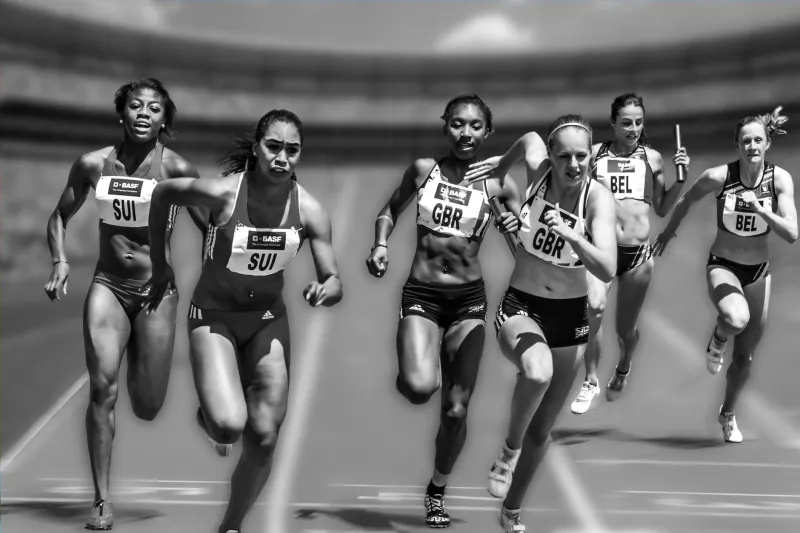
Where Races Are Actually Won: A Complete Guide to Fixing Your Relay Handoff

You can have the four fastest runners in the state on your relay team. Doesn't matter. If your handoffs are sloppy, you're losing. This isn't a motivational cliché — it's basic relay math. A fumbled exchange costs somewhere between 0.3 and 0.8 seconds depending on severity. At the high school and club level, that's the difference between a medal and a memory. At the elite level, it's the difference between a record and a disqualification.
Yet for all the emphasis coaches put on split times and training volume, the exchange zone remains the most undertrained element in competitive relay racing. Modesto coaches and athletes who've spent years obsessing over this two-second window have developed a clear-eyed view of why handoffs fail — and a practical system for making them bulletproof.
The Three Ways Handoffs Fall Apart
Before you can fix a broken exchange, you have to understand what's actually breaking. According to experienced relay coaches in the Modesto area, virtually every failed handoff traces back to one of three root causes.
Timing errors are the most common. The incoming runner and the outgoing runner are simply out of sync — the outgoing athlete starts too early and outruns the baton, or launches too late and gets caught flat-footed, forcing the incoming runner to slow down inside the zone. Both scenarios bleed time. The first risks a dropped baton or a zone violation. The second kills momentum at the exact moment you need it most.
Communication breakdowns are the second culprit. The verbal cue — usually a sharp "hand" or "stick" — is the trigger that tells the outgoing runner to reach back. If that call is too quiet, too late, or delivered with inconsistent timing, the outgoing runner either guesses wrong or doesn't react at all. In a noisy stadium environment, this problem gets significantly worse.
Mechanical inconsistency is the third and subtlest issue. This is about hand position, arm angle, and baton placement. An outgoing runner who extends their arm at a slightly different angle each time creates an unpredictable target. An incoming runner who places the baton high versus low, or pushes versus places, forces micro-adjustments that cost fractions of seconds and increase drop risk under fatigue.
What the Zone Actually Demands
Let's talk geometry for a second. The legal exchange zone in standard relay racing is 20 meters long. That sounds like a lot of room until you account for the speeds involved. At peak velocity, a 400-meter relay runner is covering roughly 10 meters per second. That means the entire legal window — from the moment the incoming runner enters the zone to the moment the baton must be transferred — lasts about two seconds in real time.
Two seconds. Less time than it takes to read this sentence out loud.
Within that window, two athletes moving at high speed have to coordinate acceleration, positioning, verbal communication, and physical contact — all without looking at each other or slowing down. Understanding just how compressed that timeline is changes how coaches approach practice. Every tenth of a second of hesitation, every slightly mistimed cue, every imprecise hand position becomes magnified.
"A lot of teams practice handoffs casually," notes one Modesto club coach who's produced multiple regional relay finalists. "They jog through them, walk through them, treat them like a formality. But the zone doesn't care how many times you practiced at half speed. It only cares what you do at race pace, under pressure, when you're already running hard."
The Mechanics That Actually Matter
Breaking down clean handoffs from race footage reveals a set of consistent mechanical principles that Modesto's most reliable exchange teams have internalized.
Outgoing runner stance and mark: The outgoing runner needs a precise check mark — a visual cue on the track that tells them exactly when to begin accelerating. This mark isn't guesswork; it's calculated based on the incoming runner's stride length and speed. Most experienced teams recalibrate this mark throughout the season as fitness levels change.
Arm extension: The outgoing runner's receiving hand should be extended fully, palm open and facing back, thumb pointed down and fingers up. This creates the largest possible target for the incoming runner. A half-extended arm — the most common mechanical flaw coaches see at the youth and club level — shrinks that target significantly.
The push, not the place: The incoming runner should drive the baton forward into the outgoing hand with a short, controlled push. This keeps the exchange aggressive and reduces the chance of a light, fumble-prone contact. "We cue it as 'push through the hand,'" says one Modesto coach. "If you're placing it gently, you're already thinking about the wrong thing."
Eyes forward: The outgoing runner should never look back for the baton. Ever. The moment they turn their head, they break their acceleration and shift their center of gravity. The baton comes to them — they don't go looking for it.
Drills That Build Reliable Exchanges
Knowing the mechanics is one thing. Building muscle memory that holds up at race pace under race-day adrenaline is another. These are the drills Modesto relay programs use most consistently to develop clean, repeatable handoffs.
Standing exchange repetitions: Start with both runners stationary, focusing purely on arm position, hand placement, and the verbal cue. Do this until the mechanics are automatic. Boring? Yes. Essential? Absolutely.
Rolling start progressions: Begin at a jog and gradually increase speed across multiple sessions. The goal is to find the minimum speed at which timing errors start to appear — that's where real practice begins.
Blindfold receiving drills: The outgoing runner extends their arm and receives the baton without looking back, relying entirely on the incoming runner's verbal cue and consistent placement. This builds trust in the system and eliminates the head-turn habit fast.
Zone pressure sets: Full-speed exchange practice with a coach standing at the zone boundaries calling out zone violations in real time. The added consequence sharpens focus and simulates race-day pressure better than any other drill.
The Mental Side Nobody Talks About
Here's what separates the teams that nail handoffs consistently from the ones that are always one race away from disaster: trust. The outgoing runner has to trust that the call is coming at the right moment. The incoming runner has to trust that the arm will be there. Both athletes have to trust the system they've built together enough to stop second-guessing it mid-race.
That trust is built in practice — not in pep talks. When a team has run clean exchanges at race pace hundreds of times, the zone stops being a source of anxiety and becomes a source of confidence. That shift in psychology is visible on race day. You can see it in how smoothly the arm comes back, how quickly the baton moves, how both runners accelerate out of the exchange without hesitation.
The handoff isn't a moment to survive. For Modesto's best relay teams, it's a moment to attack. And that mindset starts long before race day.