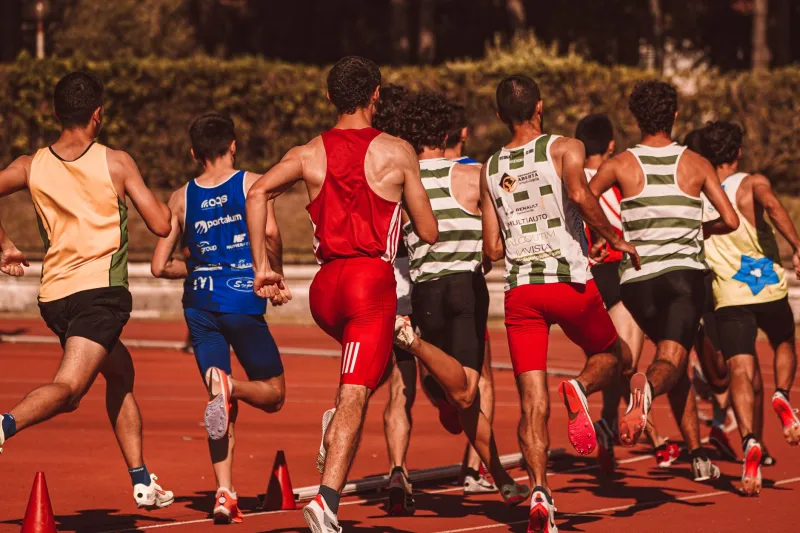
Why Relay Running Is Changing What It Means to Be a Track Athlete

Photo by Photo by Nguyen Thu Hoai on Unsplash on Unsplash
Track and field has always had an image problem when it comes to team sports. Ask a kid in middle school what a team sport looks like, and they'll probably describe a basketball court or a soccer field—somewhere that the collective effort is obvious, where you can see the collaboration happening in real time. Track? That's the sport where everyone runs their own race and you add up the points afterward.
Relay running has been quietly dismantling that image for years. And in communities like Modesto, where relay programs have deep roots and a genuine culture around them, the shift is becoming impossible to ignore.
A Different Kind of Track Kid
Spend time around a well-run relay program and you start to notice something about the athletes in it. They talk differently about competition. They talk about "we" a lot—not in the performative way that athletes sometimes do in postgame interviews, but in the way that reflects how they actually experienced the race. The baton pass. The split they ran to set up the anchor. The moment they hit the exchange zone and felt the incoming runner's pace change.
They also tend to stick around longer.
Retention is one of the quiet crises in youth track. The dropout rates in individual track events—particularly among athletes who plateau or don't see immediate competitive success—are significant. The reasons are predictable: without a team identity to anchor them, athletes who aren't winning don't have a compelling reason to keep showing up.
Relay programs change that calculus. When your performance matters to three other people, and when those people know your name and are counting on you, the motivation to train through a rough stretch is different. It's not just about your own improvement. It's about not letting people down—and more positively, about being part of something that can succeed even when individual performances are imperfect.
"I had a kid last year who had a really rough spring as far as his individual times went," says one Modesto youth coach. "But his relay team qualified for the regional championship. He was part of that. He came back the next season because of that experience. I genuinely don't think he would have if he'd only been running individual events."
What the Research Suggests
The sports psychology literature on team-based motivation is pretty consistent: athletes in team settings show stronger long-term engagement, better recovery from performance setbacks, and higher rates of continued participation into adulthood than their counterparts in purely individual sports.
The mechanism isn't mysterious. Humans are social animals. We're wired to find meaning in collective endeavor. When athletic competition is framed as a shared project—when your success and your teammate's success are genuinely intertwined—the emotional stakes change in ways that tend to sustain engagement over time.
What makes relay running particularly interesting is that it sits at a unique intersection: it's technically an individual athletic act (you run your leg alone) embedded within a collective structure (the team's result depends on all four of you). That combination seems to produce something distinct from both pure individual sport and classic team sport.
Athletes in relay programs report feeling both personal accountability—my leg matters—and collective identity—this is our result. Research on high-performing teams in other contexts suggests that this combination is unusually powerful as a motivational structure.
Modesto as a Case Study
Modesto's relay community didn't develop its current culture by accident. The programs here have made deliberate choices about how they frame competition, how they structure practice, and what they celebrate publicly.
Team splits get announced at practice, not just individual times. Post-race analysis focuses on the relay as a unit—where did we gain time, where did we lose it, what does the team need to work on—before it zooms in on individual performance. Younger athletes are routinely paired with older ones in training, creating mentorship dynamics that build cross-age bonds within the program.
The result is a culture where athletes identify with the program as much as with their individual event. That identity persists even when individual results are disappointing. It creates what one Modesto coach describes as "stickiness"—athletes who stay connected to the program, who come back for alumni events, who recruit their younger siblings and neighbors.
"We have kids who ran with us five years ago showing up to watch our meets," says one program director. "They're in college, they've got their own lives, but they still feel like this is their team. That doesn't happen when you're just a collection of individual runners."
The Identity Shift
Perhaps the most significant thing happening in relay-focused track programs is an identity shift in how young athletes understand themselves as competitors.
The traditional track athlete identity is deeply individual. Your PR is yours. Your ranking is yours. Your college recruitment is built on your individual performances. That structure produces a certain kind of athlete—disciplined, self-reliant, internally motivated—but it also produces a certain kind of limitation. Athletes who define themselves entirely through individual performance have nowhere to go when that performance stalls.
Relay athletes tend to build a more layered identity. Yes, they care about their individual times. But they also carry a sense of themselves as contributors, as teammates, as people whose value to a program isn't reducible to a single split. That layered identity is more resilient. It survives the inevitable rough patches in athletic development.
It also, interestingly, tends to produce better individual athletes. When athletes aren't solely focused on their own PR, they often run with less anxiety and more freedom—which, counterintuitively, leads to better individual performances over time.
What's Coming
The cultural shift in youth track toward relay-centered programming is still in its early stages nationally, but the trajectory is visible. Programs in cities across the country are restructuring their youth development models around relay competition as an anchor—not just as one event among many, but as the organizing principle of how teams train and compete together.
Modesto is ahead of that curve. The infrastructure here—the meets, the coaching networks, the multi-age programs that create pathways from youth competition to adult participation—represents a model that other communities are starting to look at closely.
What's being built here isn't just a faster relay team. It's a different kind of athlete: one who runs fast and runs with purpose, who understands that the finish line means more when you cross it for someone else too.
Run together. Compete together. Win together. In Modesto, that's not just a motto. It's becoming a way of life.