It's Not About You Anymore: The Mental Shift Modesto Relay Runners Have to Make

There's a moment that almost every relay runner remembers — the first time they realized that their individual best wasn't enough on its own. Maybe it was a dropped baton. Maybe it was watching a teammate struggle on the anchor leg after they'd already run a personal record. Maybe it was the realization, mid-race, that the outcome was completely out of their hands.
That moment is uncomfortable. And it's also, according to many Modesto relay runners, one of the most transformative experiences in their athletic lives.
Running relay is a fundamentally different psychological experience than competing solo. It demands a kind of mental flexibility that most athletes — even experienced ones — have to actively develop. And the Modesto running community, with its deep culture of team competition, has become something of a proving ground for that transformation.
The Lone Wolf Problem
Most competitive runners start out as individual athletes. You train alone, you race alone, and your results are yours. When something goes right, the credit is yours. When something goes wrong, so is the blame. There's a certain psychological simplicity to that arrangement — uncomfortable as it sometimes feels.
When you step into a relay squad, that whole framework gets flipped. Suddenly, your race depends not just on your own preparation and execution, but on three other people's. And their race depends on you.
For a lot of athletes, that's the hardest part of the transition. "I was so used to controlling everything about my race," says Marcus, a 400m specialist who joined a relay squad for the first time last spring. "My warm-up routine, my lane, my splits. In a relay, you hand the baton off and then just... watch. That was hard for me at first. I had to learn how to let go."
That need for control is deeply wired into competitive athletes. It's often what makes them good at individual events. But in a relay context, it can become a liability — creating tension with teammates, disrupting trust, and adding unnecessary mental weight to an already high-pressure situation.
Redefining What 'Winning' Looks Like
One of the most significant mindset shifts relay runners describe is learning to redefine personal success. In individual racing, a PR is a PR — full stop. In relay competition, you might run the fastest split of your life and still finish last if the team around you struggles.
Conversely, you might have a rough leg and still come away with a first-place finish because your teammates picked you up. Neither outcome maps neatly onto the individual athlete's internal scorecard.
"I ran a leg I wasn't proud of at one of our early meets," recalls Destiny, a middle-distance runner who competes with a local club team in Modesto. "I came off the track feeling terrible. But we still won. And honestly? It took me a while to feel good about that. I had to really examine why I couldn't just celebrate with my team."
That kind of honest self-reflection is exactly what the relay format demands. It forces athletes to interrogate their motivations — are you running for the team, or are you running for your stats? — and find a way to genuinely invest in collective outcomes.
Managing the Handoff: Anxiety at Its Peak
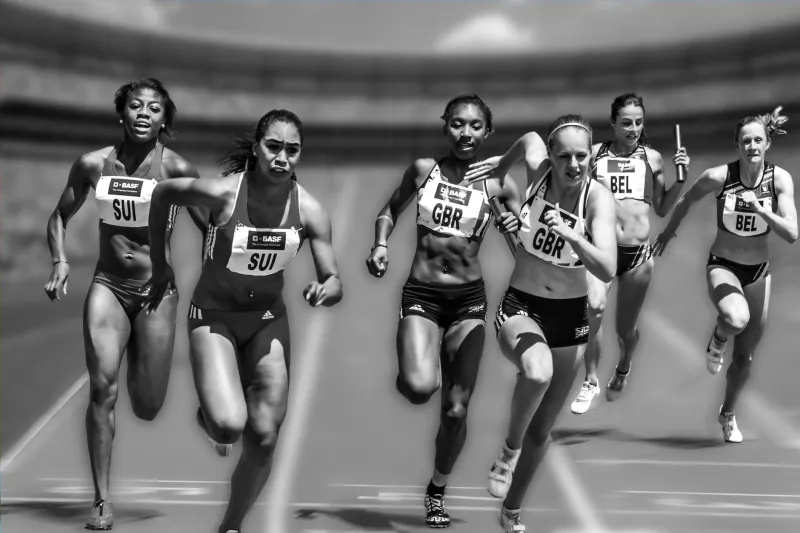
If you've ever stood in an exchange zone waiting for the incoming runner, you know the feeling. Your legs are bouncing. Your eyes are scanning the track. Your heart rate is climbing before you've even taken a step. That's pre-handoff anxiety, and it's one of the most psychologically intense moments in all of track and field.
The anxiety isn't irrational. A lot can go wrong in those few seconds. The baton can be dropped. The timing can be off. The incoming runner might be more exhausted than expected. And you're standing there, completely dependent on someone else's execution before you can even begin your own.
Experienced relay runners say the key is having a clear pre-handoff routine that redirects mental energy away from what might go wrong and toward what you're trained to do. Focus on your start position, your acceleration cue, your visual check — the physical mechanics of what you control. Let the rest go.
"I used to watch my incoming runner the whole time and try to read how tired they looked," says Jerome, a sprinter who's been competing in relay events in the Central Valley for several years. "That just made me more anxious. Now I focus on my own setup and trust that she's going to get there. We've practiced the exchange hundreds of times. My job is to be ready, not to worry."
That trust — earned through repetition and reinforced through relationship — is the foundation of everything.
Team Chemistry Isn't a Bonus, It's a Requirement
Ask any relay coach what separates good teams from great ones, and the answer almost always comes back to chemistry. Not just talent distribution or training loads, but the intangible quality of athletes who genuinely want each other to succeed.
In Modesto's relay community, that chemistry gets built in practice, yes — but also in the spaces between practice. In the conversations before meets, the shared warm-up rituals, the post-race debrief where everyone's honest about what happened and what they can do better.
When team chemistry is strong, it becomes a form of mental armor. Athletes who trust their teammates are more resilient under pressure. They're less likely to spiral after a mistake because they know their squad has their back. They're more willing to take risks — push harder on their leg, attempt a tighter exchange — because the collective safety net is real.
When chemistry is weak, even a talented relay squad can fall apart at the worst possible moment.
The Unexpected Gift of Running Together
Here's the thing that surprises most athletes who make the jump to relay competition: the team format doesn't just add pressure. It also adds something that individual racing rarely provides — genuine shared joy.
When a relay team crosses the line and wins, or smashes a team PR, or finally nails the exchange they've been working on for weeks, the celebration is different from anything you experience alone. It's louder, more chaotic, and in many ways more meaningful.
"There's nothing like it," Destiny says simply. "You worked for it together. You suffered for it together. And you get to feel it together."
That's the heart of what relay racing is about — and why so many Modesto athletes, once they make the mental shift, never want to go back to running alone.